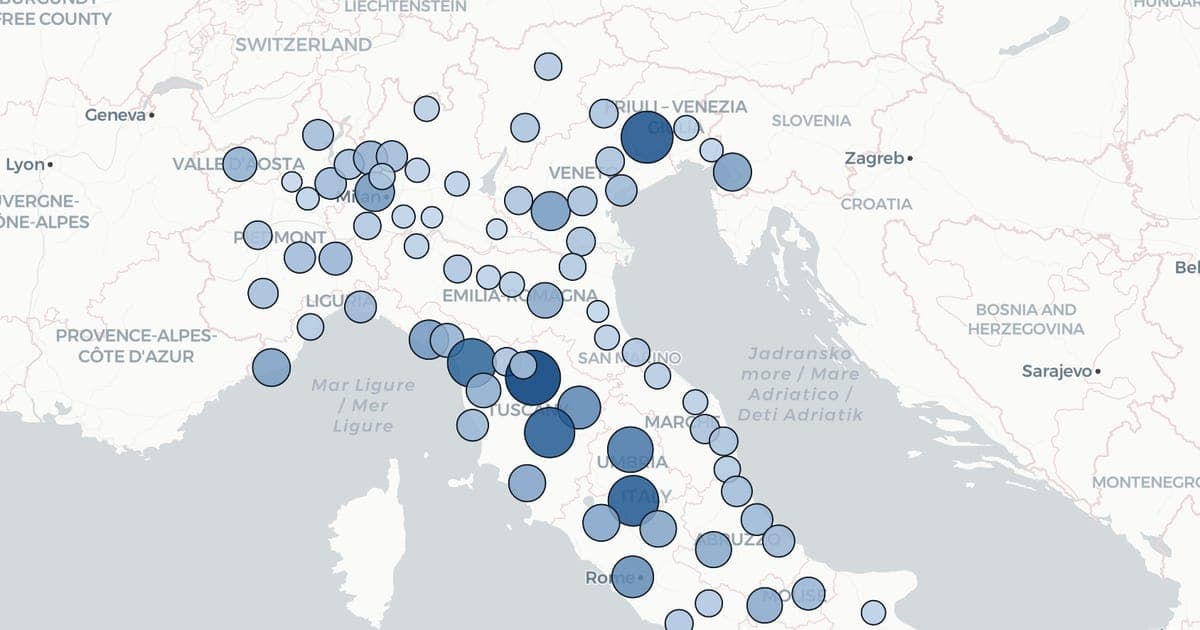
If you sort Italy's 7% pensioner map by property price, Abruzzo comes up again and again.
That makes sense. Almost the whole region sits on the map: 297 of Abruzzo's 305 comuni appear on it, and a good number of them are inexpensive by almost any standard.
The price list leaves out one thing, though. It tells you nothing about January.
When I put the cheapest Abruzzo towns next to our new climate data, a pattern appeared that I had not expected. The lowest prices cluster in the mountain basins of the province of L'Aquila, and those towns are also, by some distance, the coldest and wettest on the list. Toward the coast, in the hills of the provinces of Chieti, Pescara and Teramo, prices roughly double and the winters become much softer.
I am writing about it because many of us will first see these towns in summer, when that difference is hardest to feel.
Six towns, from the mountains to the hills above the sea
I picked six towns on the 7% map that show the range well: three in the mountain basins of the Marsica and the Valle Peligna, and three in the hills that look toward the Adriatic.
| Town | Province | Residents | Price per m² | January low | Days above 30°C | Rainy days |
|---|---|---|---|---|---|---|
| Gioia dei Marsi | L'Aquila | 1,688 | €385 | -2.6°C | 4 | 136 |
| Pescina | L'Aquila | 3,648 | €438 | -1.3°C | 16 | 134 |
| Pratola Peligna | L'Aquila | 6,936 | €453 | -1.8°C | 17 | 151 |
| Scerni | Chieti | 2,936 | €673 | 2.6°C | 33 | 114 |
| Città Sant'Angelo | Pescara | 14,902 | €871 | 2.9°C | 31 | 113 |
| Atri | Teramo | 9,846 | €904 | 2.6°C | 33 | 107 |
Prices: Agenzia delle Entrate OMI, second half of 2025, ordinary residential property. Climate: Copernicus ERA5-Land, averages for 2015–2024. A rainy day is a day with at least 1mm of rain. Residents: ISTAT, 2025.
As the price rises down the table, the climate columns move with it, almost step for step.
The mountain towns: very low prices and real winters
Gioia dei Marsi is the cheapest of the six, at about €385 per square meter, which makes it cheaper than 98% of Italian comuni. It is also small, with 1,688 residents, and its winters are cold: January lows average about minus 2.6°C. It gets about 1,050mm of rain a year, spread across roughly 136 days, and only about four days a year above 30°C.
It is worth knowing, too, that very few foreign residents live there. Of the 25 nationalities we track, Gioia dei Marsi has exactly one resident, which puts it in the bottom ten percent of Italian comuni for foreign residents. For some people that is the whole appeal. For others it would feel isolating.
Pescina, also in the Marsica, is a little larger, with 3,648 residents, and costs about €438 per square meter. January lows average about minus 1.3°C, and the town sees about 16 days a year above 30°C and around 134 rainy days.
Pratola Peligna, a neighbor of Sulmona in the Valle Peligna, is the largest of the three, with 6,936 residents, at about €453 per square meter. It has the most rainy days of any town in the table, roughly 151 a year, and January lows of about minus 1.8°C. One small curiosity: Pratola Peligna has 51 residents with Venezuelan citizenship, the eighth-highest concentration of Venezuelans among Italian comuni with at least 1,000 residents.
There is a great deal to like in these towns. Summers are mild, with between four and 17 days a year above 30°C, which many people come to appreciate more with every passing decade. The province of L'Aquila also scores in the top quarter of Italian provinces on ISTAT's well-being measures for hospital beds in high-care wards and for air quality (PM10).
But the winters are real winters, and the rain comes often.
The hill towns toward the Adriatic: roughly double the price, but much softer winters
Scerni, in the province of Chieti, is a small hill town of 2,936 residents. A square meter costs about €673 there, and January lows average about 2.6°C, with roughly 33 days a year above 30°C and about 114 rainy days.
Scerni also has one of the more interesting price-to-rent figures of the six. About 18.4 years of rent there equal the purchase price, below the national median of 22.2 years. That ratio leaves out taxes, maintenance and everything else that comes with owning a home, so I would treat it as a hint rather than a verdict.
Città Sant'Angelo, in the province of Pescara, is the largest town in the table, with 14,902 residents, and costs about €871 per square meter. Its January lows average about 2.9°C, and it sees about 31 days a year above 30°C and around 113 rainy days.
Atri, in the province of Teramo, has 9,846 residents and costs about €904 per square meter, the most of the six. Its climate is very close to Scerni's: January lows of about 2.6°C, about 33 days a year above 30°C and roughly 107 rainy days, the fewest in the table.
None of these three is expensive by Italian standards. Each is still about twice the price of the mountain towns.
What about Introdacqua?
Some readers will know Introdacqua from our piece on where different nationalities live in Italy. It has 27 residents with U.S. citizenship out of 1,932, or 1.40%, the highest share of Americans among the 5,872 Italian comuni with at least 1,000 residents.
It sits firmly in the mountain group. A square meter costs about €555, January lows average about minus 2.5°C, and the town gets roughly 150 rainy days and about seven days above 30°C a year.
Twenty-seven people is a small community, and I would not draw broad conclusions from it. It is a useful reminder, though, that the Americans who chose Introdacqua chose a mountain winter along with it.
What the price difference seems to buy
Put simply, in this part of Abruzzo the extra €200 to €500 per square meter appears to buy you a winter that stays above freezing at night, and fewer rainy days. It also buys a longer, hotter summer, which some people will count as a cost rather than a benefit.
I would be careful not to read the whole price gap as a climate premium. The hill towns also sit closer to the coast and to the larger towns along it, and that most likely feeds into what people pay as well. Our data can show that cheaper and colder tend to go together here. It cannot tell us how much of the gap each factor explains.
Healthcare does not separate the two groups at all. Italy's regions run the public health system, so every town in Abruzzo shares one set of Ministry of Health scores: 80 for prevention, 74 for community and district care, and 75 for hospital care in 2024, all above the official sufficiency line of 60. What differs from town to town is how far you are from the services you would use most.
Before choosing between them
If you are weighing a mountain town against a hill town, these are the questions I would look at first.
What will a January evening look like for you? Average lows below freezing mean heating costs, icy mornings and, in some years, snow. It is worth asking how well an old stone house holds heat before you fall in love with it.
Will you drive your car, and for how long? The smallest towns here have fewer than 2,000 residents. Daily shopping, a pharmacy and a doctor may be a drive away, and that drive becomes harder in winter and as we get older.
How much heat do you actually want? Thirty-odd days a year above 30°C is pleasant for some people and exhausting for others. The mountain towns trade a hard winter for a gentle summer.
Who else would be around you? Some of these towns have almost no foreign residents. That can be wonderful for your Italian, and lonely in your first year.
A few important limitations
OMI averages each town across its micro-zones. Gioia dei Marsi's figure covers two OMI zones and Atri's covers five, and prices can differ a great deal inside one town. The figures describe ordinary residential property in normal condition, which is a guide to the market rather than a valuation of any particular house.
The climate data works at a grid of roughly 9 kilometers. It describes the town as a whole. A house on a valley floor and one on the ridge above it can feel very different, and the data cannot separate them.
The 7% map describes towns, not people. Our map shows 2,535 comuni and counting. Whether the regime applies to you depends on where you were tax-resident before and where your income comes from, so it is worth checking whether you qualify with a professional before planning around it. You can read how the regime works on our 7% page.
Foreign-resident figures count citizenship. Americans who hold Italian citizenship by descent appear as Italians, so the American numbers here undercount people with an American background.
A note on the numbers
Prices come from the Agenzia delle Entrate's OMI for the second half of 2025 (2025H2). Climate figures come from the Copernicus ERA5-Land reanalysis, averaged over 2015–2024 and matched to the nearest grid cell for each comune. Resident and citizenship counts come from ISTAT for 2025. Regional healthcare scores come from the Ministry of Health's NSG for 2024, and province well-being from ISTAT's BES. You can open every town in this piece on its own page, with the source and date next to each number.
If you live in one of these towns, or have spent a winter in the Abruzzo mountains, I would love to hear how it compared with what you expected. Was the cold harder than you imagined, or easier? And if you chose the hills instead, what made you decide?