When people think about retiring in Italy, healthcare is often treated as a national question: does Italy have good healthcare? For a move that may last ten or twenty years, that question is too broad to be very useful.
What matters more is what care looks like in the region — and eventually the province and town — where you may actually live.
Italy has the Servizio Sanitario Nazionale, or SSN. Residents who are enrolled can access public healthcare, and the system is built around national standards. But the services themselves are largely organized and delivered by the regions.
That means the healthcare experience can vary depending on where you live. The official data makes those differences visible.
Why can healthcare feel different from one part of Italy to another?
Italy sets national Livelli Essenziali di Assistenza — the essential levels of care the public system is meant to provide. The regions are responsible for organizing the services that deliver them.
The Ministry of Health (opens in a new tab) monitors regional performance through the Nuovo Sistema di Garanzia, or NSG. It scores three broad areas from 0 to 100, with 60 used as the official sufficiency threshold.
The three areas measure different parts of the system:
Prevention: vaccination, screening, public-health programs and other services intended to prevent illness or detect it earlier.
District or community care: the care you use outside a hospital, including local health services, outpatient care and chronic-disease management.
Hospital care: how the hospital system performs.
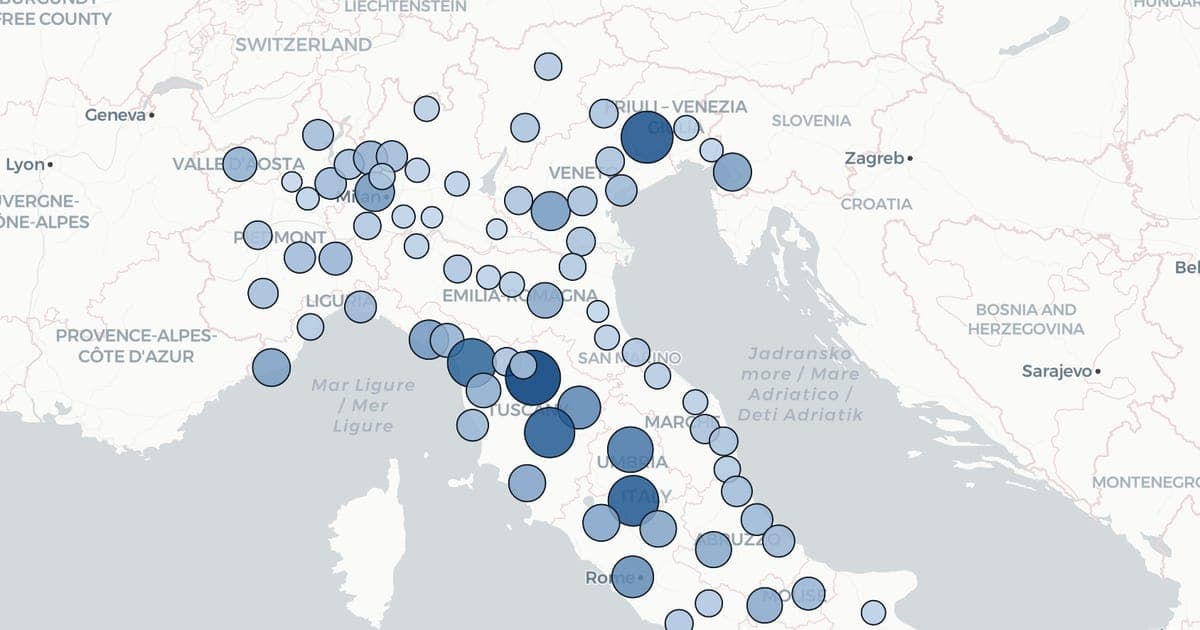
We have now put all three measures into separate maps on Expat Living Italy: healthcare prevention by region, district and community care by region, and hospital care by region.
Looking at the three together matters because a region can perform very differently depending on which part of healthcare you are measuring.
Why is hospital care only part of the picture?
Abruzzo is a good example. In the Ministry’s 2023 NSG results, Abruzzo scored 83 for hospital care, comfortably above the sufficiency threshold. But it scored 54 for prevention and 45 for district care.
Sicily shows a similar pattern: 80 for hospital care, but 49 for prevention and 44 for district care.
For someone deciding where to retire, that distinction matters. Most of your contact with healthcare will not happen in a hospital. As you get older, routine appointments, diagnostics, chronic-disease management, follow-up care and prevention can become just as important.
So when someone says a region has “good healthcare,” it is worth asking what part of the system they mean.
Which regions perform well across all three areas?
Some regions perform strongly across prevention, community care and hospitals.
Tuscany scored 95 for prevention, 95 for district care and 96 for hospital care. Veneto scored 98, 96 and 94. Emilia-Romagna scored 97, 89 and 92.
The Ministry reported that 13 regions or autonomous provinces were above the 60-point threshold in all three areas in the 2023 assessment. Others fell below it in one or two areas.
That does not mean you should automatically choose Tuscany, Veneto or Emilia-Romagna. A regional score cannot tell you how long you will wait for a specific appointment, how close the nearest specialist is or what your experience will be with an individual hospital.
But it is a useful first signal when you are comparing places.
Why do healthcare scores and health outcomes tell you different things?
The Ministry’s NSG data measures how regional health systems perform against the essential levels of care. ISTAT’s BES data tells us something different: what health and well-being look like in the population.
Our BES explorer lets you compare all 107 Italian provinces across health and ten other domains. The health indicators include measures such as life expectancy and avoidable mortality, alongside other outcomes.
This gives you two useful views. You can look at how the regional healthcare system performs, then look at the health picture in the province where you are considering living.
Neither is a complete answer on its own, but together they give you a more useful starting point.
What should you check before choosing a town?
If healthcare is an important part of your move, I would add four questions to the usual property and lifestyle checklist.
-
How does the region perform on prevention, district care and hospital care?
-
What do the province-level BES health indicators look like?
-
How far is the town from the services you are likely to use regularly, not just the nearest hospital?
-
How does that healthcare picture balance against the other things that matter to you, such as housing cost, community, transportation, climate and access to family?
That last question matters because the region with the strongest healthcare scores may not be the place that works best for your life.
A town with excellent regional healthcare but housing you cannot afford will not solve the problem. A very cheap house that leaves you dependent on a long drive for routine care may not either.
You can compare official property prices in our OMI housing data, explore broader quality-of-life indicators in BES, and then open individual comune profiles as you narrow the shortlist.
How should you use the healthcare maps when comparing places?
I would use them as a screening tool rather than as a ranking.
A healthy retiree may care most about prevention and easy access to a primary care doctor. Someone managing a chronic condition may put more weight on district care. Someone who already knows they will need specialist treatment may look much more closely at hospitals and referral centers.
Those are different needs, even though all three people may begin with the same question: where in Italy has good healthcare?
The useful answer depends on the kind of care you expect to need and how much access matters in your day-to-day life.
What can the data not tell you yet?
There are important limits to this first version of the healthcare picture.
The regional NSG scores do not tell us whether a doctor speaks English. They do not tell us the waiting time for the specialist you personally need. And they do not yet give us a clean, comparable town-by-town measure of how long it takes to reach a hospital, primary care doctor or pharmacy.
Those are exactly the gaps we want to work on next.
For now, if you have narrowed your move to two or three areas, the healthcare maps can help you see where you should ask more detailed questions before you sign a lease or buy a house.
Where should you start if healthcare matters to your move?
Start with the three healthcare layers: prevention, district and community care, and hospital care.
Then use the BES explorer to look at health outcomes and quality of services at the province level, and our comune profiles to bring the decision back down to the place you may actually call home.
The question is not simply whether Italy has good healthcare.
It is whether the healthcare around the place you want to live will still work for you five, ten or twenty years from now.